
Our voices at the United Nations: Down Syndrome International at COSP19
In June 2026, Down Syndrome International travelled to the United Nations in New York for one of the most important disability rights events in the world.
COSP — the Conference of States Parties to the Convention on the Rights of Persons with Disabilities — is an annual gathering where member countries, organisations and advocates from around the world come together to talk about disability rights. “States Parties” is a formal way of saying the countries that have signed up to the Convention and made a commitment to uphold it. At COSP, they look at what has changed, and what still needs to change.
This year was special. 2026 marks 20 years since the Convention on the Rights of Persons with Disabilities — the CRPD — was adopted by the United Nations.
The CRPD is a landmark human rights treaty. It changed how the world understands disability. It says that people with disabilities are not people to be pitied or fixed. They are people with rights. Rights to dignity. Rights to equal participation. Rights to have a say in the decisions that affect their lives.
At Down Syndrome International, the CRPD is the foundation of everything we do. And at COSP19, we were there to say so.
DSi President Bridget Snedden opens the conference
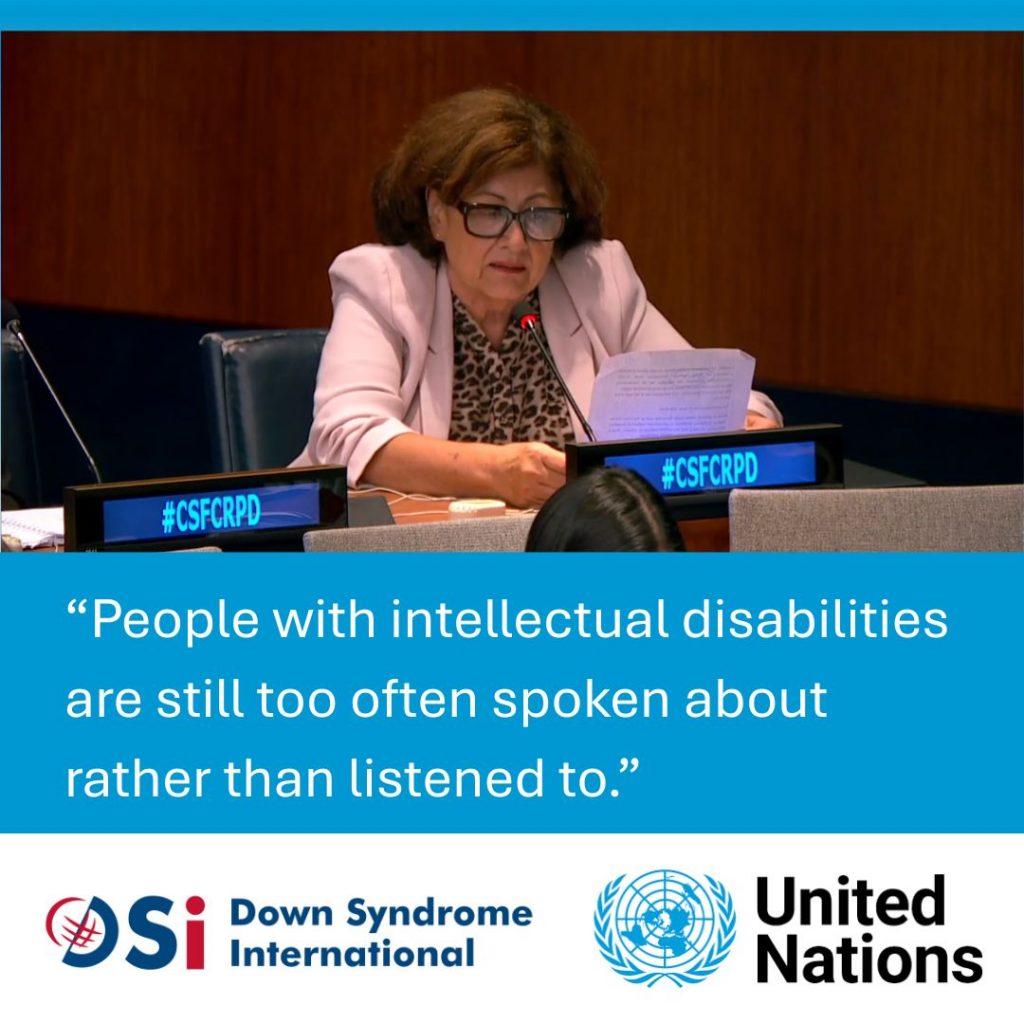
Our President, Bridget Snedden, had the honour of speaking at the opening of COSP19.
Bridget spoke about what the CRPD has achieved over 20 years. It has shifted the world away from seeing disability as a medical problem, and towards seeing it as a matter of human rights. That shift matters. It has changed laws. It has changed policies. It has changed lives.
But Bridget was honest about what still needs to change. People with intellectual disabilities — including people with Down syndrome — are still too often spoken about rather than listened to. Their voices are missing from too many conversations, including conversations that directly affect them.
Janet Charchuk speaks on democracy and inclusion
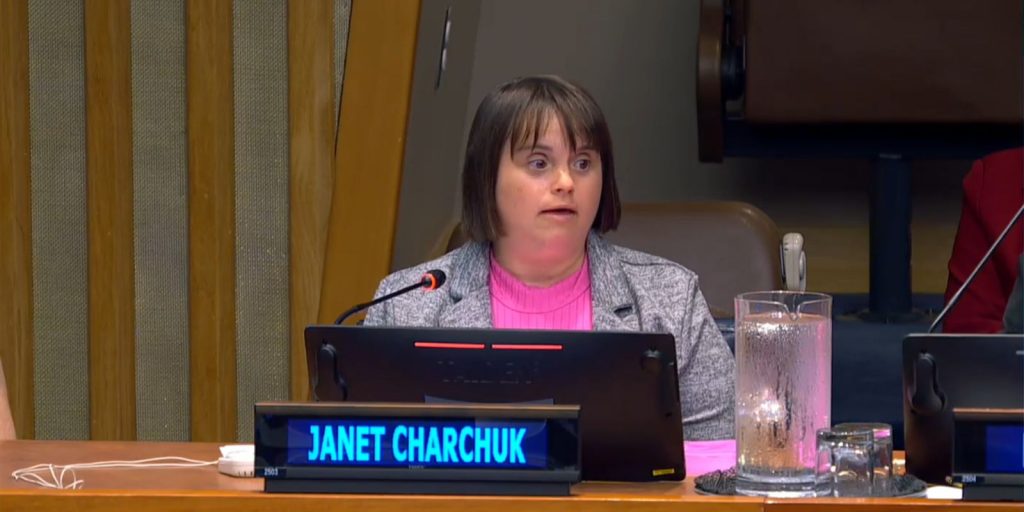
One of the most powerful moments of COSP19 came when our Board member Janet Charchuk took to the floor.
Janet, who has Down syndrome, spoke at a roundtable on From Participation to Representation. The roundtable was about how people with disabilities can move beyond being consulted — to genuinely leading and making decisions in public and political life.
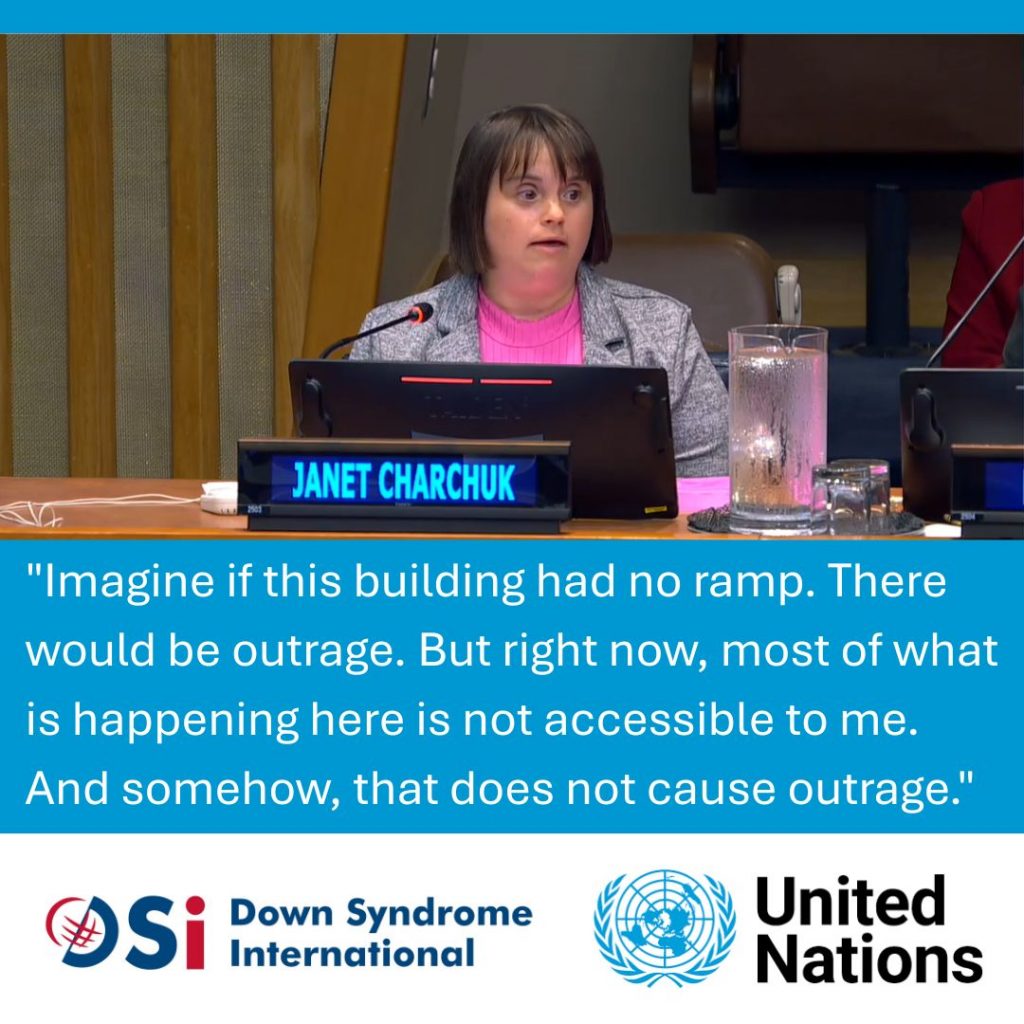
Janet opened with a simple question.
“Imagine if this building had no ramp. There would be outrage. Imagine if there was no sign language. No captions. We would all say: this is against the Convention. And we would be right.
But right now, in this building, most of what is happening is not accessible to me. The long words. The fast speech. The thick documents. And somehow, that does not cause outrage.”
She named three barriers that still keep people with Down syndrome and intellectual disabilities out of democracy. Intellectual disabilities is a term used to describe conditions — like Down syndrome — that affect how a person learns, processes information, and communicates. It does not mean a person cannot make decisions or have opinions. It means the world needs to communicate and engage differently.
The law. In many countries, people with intellectual disabilities are still not allowed to vote or stand for election. This is against two key parts of the CRPD: the right to be recognised as a person equal before the law (Article 12), and the right to take part in political and public life (Article 29). Twenty years after the Convention, this is still happening.
The way elections are run. Even where the law allows people to vote, elections are often designed in a way that makes it very hard to take part. Ballot papers are written in complicated language. Websites are not accessible. Easy-to-understand information is treated as optional — something to do if there is time and money left over. As Janet said, that is not what the Convention says.
The table where decisions are made. When people with Down syndrome were invited into consultations, the meetings were often not designed for them to take part. Documents were too long. Things moved too fast. Nobody checked if people understood. “We are in the room,” said Janet, “but we cannot really be in the conversation. That is not participation. That is decoration.”
Janet called on every government at COSP to do three things:
- Change every law that takes away the right to vote or stand for election because of disability.
- Make easy-to-understand information the standard — in elections, in laws, in public life. Not on request. The default.
- Include people with Down syndrome and intellectual disabilities in consultations — with accessible materials, enough time, and genuine listening.
None of this is radical. It is what the CRPD already promises.
As Janet put it:
“If a country would never tolerate an inaccessible building, it should never tolerate an inaccessible democracy. Twenty years is long enough to wait.”
Why this matters
Bridget and Janet’s speeches were part of something bigger.
At COSP19, DSi Board members joined conversations across the conference about the real impact of the CRPD on people with Down syndrome — and about the gaps that still need to be closed.
We were there because our community deserves to be represented at the highest levels. Because the global Down syndrome network has things to say. And because the CRPD is built on a simple principle: nothing about us without us. That means people with disabilities must be involved in every decision that affects their lives — not as an afterthought, but from the start.
Learn more about our work:

Inclusive organisations
We believe everyone should have a say in decisions that affect them.
The problem is many people with intellectual disabilities are not included in a meaningful way. This is not fair.